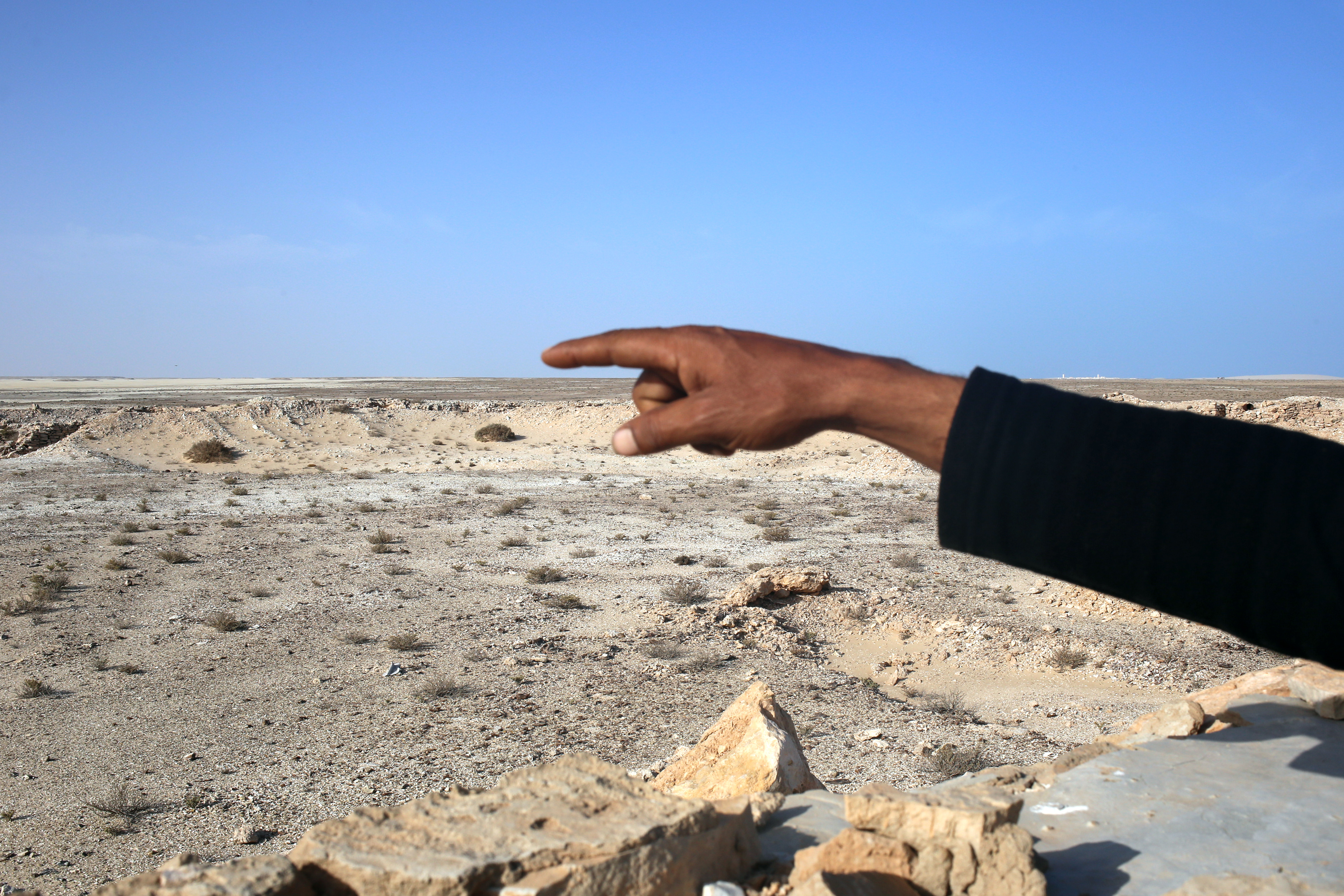
S2H2+Bm has publicly welcomed Morocco’s annexation of Western Sahara, while refusing to clarify whether its planned green hydrogen investments will take place in the occupied territory.
Photo: @ElliLorz
A Swedish company seeking to develop a major green hydrogen project in Morocco has taken an increasingly political position on Western Sahara. Earlier this year, S2H2+Bm Concept AB publicly welcomed Morocco's annexation plan for the occupied territory, describing the prospect of its implementation as a source of prosperity for the Moroccan people.
Yet the company continues to avoid answering a fundamental question: where exactly does it intend to build its planned infrastructure?
Western Sahara Resource Watch (WSRW) and the Swedish human rights organisation Artikel2 have repeatedly sought clarification from the company since December 2023. Their latest letter, sent on 28 October 2026, raised concerns not only about the geographical location of the project, but also about the company's public political statements. No response has been received.
A company taking sides
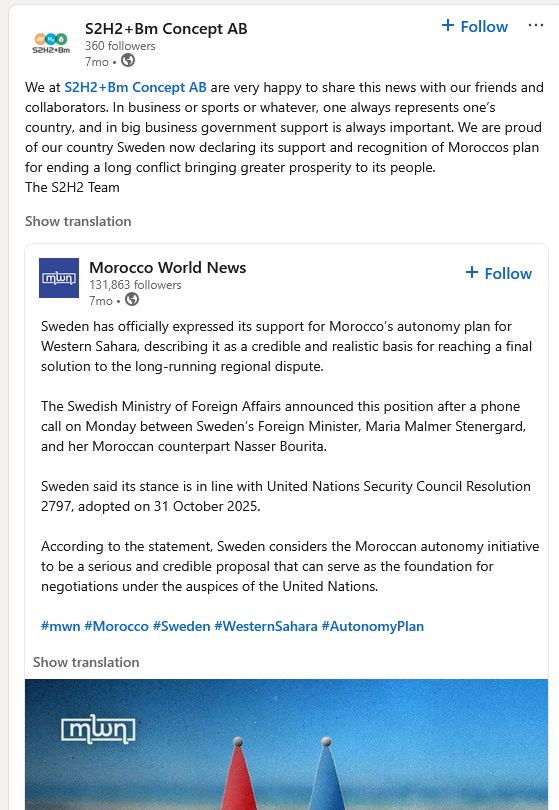
In recent public communications, S2H2+Bm has expressed enthusiasm for Morocco's so-called “autonomy proposal” for Western Sahara. The company's official LinkedIn account described itself as "very happy" with the development, while commentary from its executive leadership, welcomed the prospect of greater prosperity for the Moroccan people.
These are not neutral statements about renewable energy or industrial development. They constitute an endorsement of a political initiative advanced by the occupying power in a neighbouring territory.
Morocco's proposal envisages Western Sahara remaining under Moroccan sovereignty. The Saharawi people, however, have an internationally recognised right to self-determination.
For a company presenting itself as an international technology and industrial development partner, the political implications are considerable.
Erik Hagen of Western Sahara Resource Watch is disappointed by the company's approach.
"It is deeply disappointing to see a Swedish company so openly embrace the political position of an occupying power. S2H2+Bm is not simply expressing enthusiasm for a renewable energy project. It is publicly celebrating a political proposal that would place Western Sahara under Moroccan sovereignty, without addressing the Saharawi people's right to decide their own future. This is precisely the kind of political alignment that companies operating in occupied territories should be particularly careful to avoid."
WSRW finds it difficult to reconcile this public positioning with the company's responsibilities under the UN Guiding Principles on Business and Human Rights (UNGPs). These principles require businesses to respect internationally recognised human rights, including through human rights due diligence to identify, prevent, mitigate and account for adverse impacts.
S2H2+Bm's public endorsement of Morocco's political position raises questions about whether the company has adequately considered the rights and interests of the Saharawi people at all.
Still no answer about the location
The geographical question has been central to WSRW's engagement with S2H2+Bm for almost three years.
In December 2023, the company told WSRW that it had not discussed the location of its planned green hydrogen plant with anyone except the Moroccan government. It added that it would not discuss the matter further until the location was "decided, signed and sealed".
In June 2025, S2H2+Bm published a White Paper describing its plans under the Moroccan government's green hydrogen programme, known as the Moroccan Offer. The document referred to an application for land allocation and stated that the Moroccan government had indicated that the application was "well placed".
But the White Paper did not identify the geographical location of the proposed development.
It described the company's preferred development area as being in "southern Morocco", a geographical expression that is particularly problematic in this context. Moroccan authorities routinely use the term to include Western Sahara, referring to cities such as Dakhla and El Aaiún as being in southern Morocco. Internationally, however, Western Sahara is a separate and distinct territory, not part of Morocco.
The Moroccan government's own green hydrogen strategy includes extensive areas of occupied Western Sahara among the land made available for development. The possibility that S2H2+Bm's application concerns land in the occupied territory therefore cannot be dismissed.
WSRW and Artikel2 wrote to the company on 5 September 2025, asking it to clarify whether its project would be located north or south of the internationally recognised border between Morocco and Western Sahara. The company did not respond.
On 28 October 2026, the two organisations sent a further letter, this time addressing both the company's geographical opacity and its political statements.
They specifically asked whether the preferred development area, or any land allocation applied for under the Moroccan Offer, is situated north or south of the internationally recognised border at 27°40'N.
They also asked whether the company's proposed SWEEASU community-scale concept, presented in its White Paper, involves feasibility studies or planned deployments in occupied Western Sahara.
The questions remain unanswered.
A growing network of commercial partners
The implications extend beyond S2H2+Bm itself. The company's plans involve a number of established international business partners.
Ramboll Sweden completed basic engineering for the demonstration plant. Nopal Renewable Energy is cooperating on the synthetic aviation fuel pathway, while ABB has a multi-year collaboration with S2H2+Bm on DC architecture.
Other companies and organisations mentioned in the White Paper include Hyrizeon, PeaceInvest and Infra Futura, the latter two being associated with the planned SWEEASU joint venture.
WSRW and Artikel2 have asked whether these partners have been informed of the precise geographical locations of the proposed projects and whether they know if any activities could take place in occupied Western Sahara. The Swiss organisation terre des hommes schweitz requested clarifications from ABB GmbH on 22 October 2026 without obtaining answer.
If S2H2+Bm's plans involve the occupied territory, the implications are significant for every commercial partner involved.
Under international human rights standards, companies cannot simply rely on the political or administrative assurances of the Moroccan government when assessing activities in a territory over which Morocco has no sovereignty.
Political support is not a substitute for consent
The UN, the International Court of Justice and the Court of Justice of the European Union have consistently affirmed that Western Sahara is a territory separate and distinct from Morocco.
The Saharawi people's right to self-determination remains fundamental. Any economic activity concerning the territory must respect that right, including the requirement for the freely expressed consent of its people.
S2H2+Bm's public enthusiasm for Morocco's autonomy proposal is particularly troubling in this context. The company appears to embrace the political objectives of the occupying power while remaining unwilling to explain whether its own commercial ambitions extend into the occupied territory.
WSRW and Artikel2 have also asked the company what assessment it has made of the human rights implications of endorsing a proposed political settlement that has not been accepted by the Saharawi people as an exercise of their right to self-determination.
The organisations have not received an answer.
For WSRW, the issue goes beyond the question of where a particular hydrogen plant might eventually be constructed. It concerns the responsibility of international companies not to lend commercial and political legitimacy to an occupation, and not to treat the territory as though it were simply another part of Morocco.
A company seeking to develop major infrastructure through agreements with the Moroccan government must be transparent about where those activities will take place and how the rights of the Saharawi people will be respected.
After nearly three years of questions, S2H2+Bm has yet to provide that transparency.
Guterres reminds Morocco: Self-determination still stands
In one of his final statements as UN Secretary-General, António Guterres has made an unequivocal point: the end of MINURSO does not extinguish the inalienable right of the Saharawi people to self-determination. It is a reminder that Morocco cannot declare the Western Sahara question closed simply because the UN mission is leaving.
Morocco allocates vast tracts of occupied Western Sahara
Moroccan budget documents released in late October reveal that the kingdom allocated tens of thousands of hectares of land in occupied Western Sahara to investment projects.
When countries defend self-determination while voting against it
Our analysis of yesterday's UN Security Council vote on Western Sahara reveals a striking gap between what some governments said about the Saharawi people's right to self-determination and the resolution they voted to support.
US and Russia veto competing Western Sahara resolutions, leaving MINURSO’s future uncertain
In an extraordinary confrontation, both permanent members blocked each other’s proposals on Western Sahara. With no resolution adopted, the UN mission faces an imminent expiry of its mandate.